Local SEO
Why Is My Website Not Generating Leads? Because It Just Sits There
By Rigo Guadron · · 8 min read
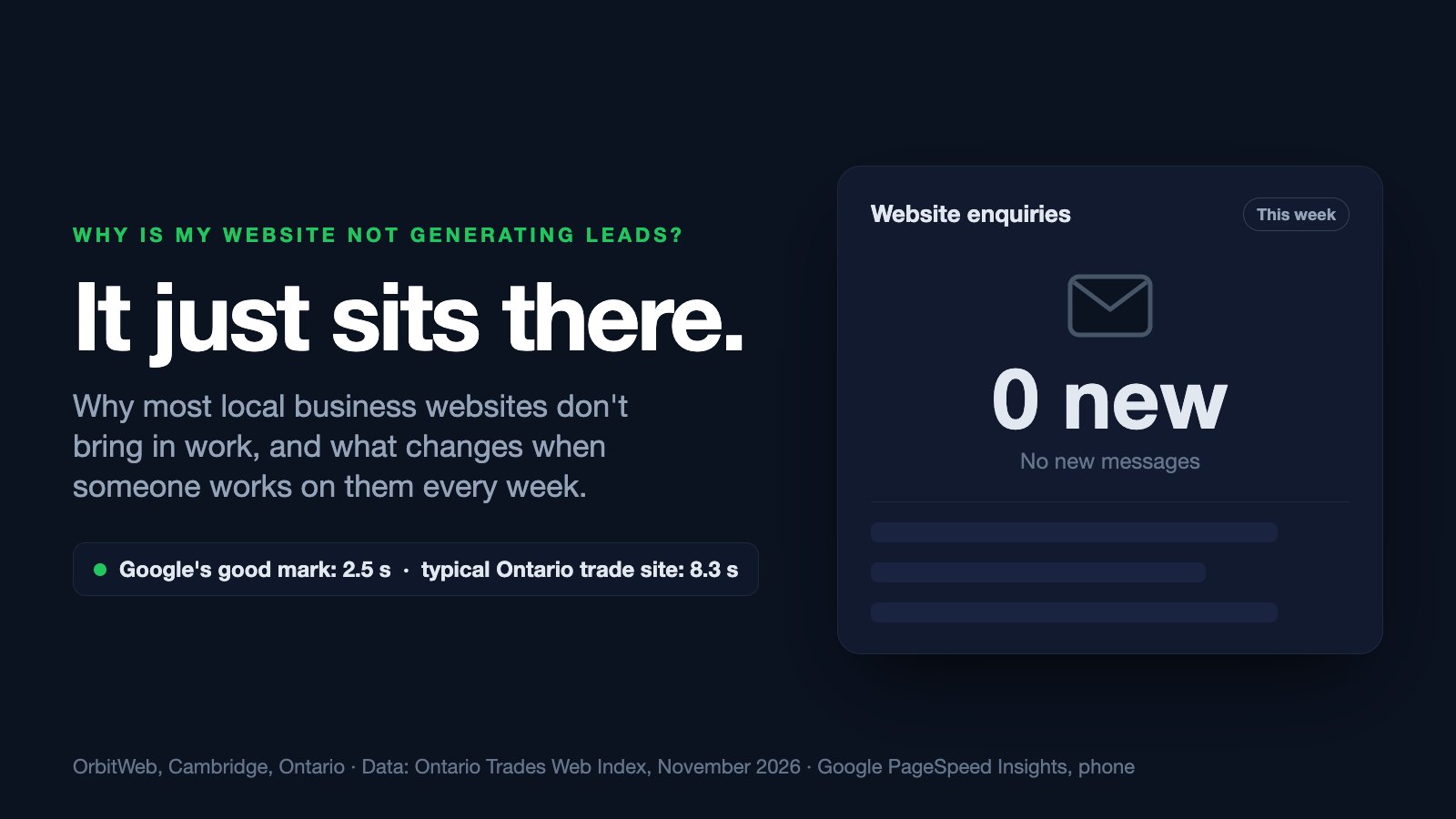
You work long days, and your website was supposed to bring in work while you're busy. Instead it just sits there. Here's why it isn't generating leads, and what changes when someone works on it every week.
Quick Answer
Why is my website not generating leads? For most local businesses, the website was built once, launched and then left alone. It loads slowly on a phone, Google can't tell exactly what you do or where, and nobody answers the people who do show up. A website brings in work when someone keeps working on it, every week.
It's 9:40 on a Tuesday night. You've been on job sites since seven. You quoted two jobs from the truck, called back three people and ate dinner standing up.
Before bed, you open the laptop and check the contact form. Nothing new, for the third night this week.
You paid good money for that website. Everyone who has seen it says it looks great. So you type the question into Google, half hoping the answer is something simple: why is my website not generating leads?
You're not the only one asking. Google suggests those exact words as you type, which tells you how many owners have searched for them before you.
Here's what I want you to hear first. If your website isn't bringing in work, it's almost never because you did something wrong. It's because of the way websites are sold.
You bought a project. You needed a system.
Most local business websites are sold the same way. You pay a few thousand dollars, someone builds it, there's a launch day, and then it goes quiet. Every change after that is a quote and a wait. So most changes never happen.
Meanwhile, everything around your site keeps moving. Google changes what it shows. Phones change. And the company down the road keeps adding pages and collecting reviews. Your site stays exactly the way it was on launch day.
That's what I mean when I say most websites just sit there. They're not broken, they're just not working.
The people who built your site did the job they were hired for. A project ends when the site launches. The work that brings in leads starts that same day.
What I see when I test local websites
This fall, we ran Google's own speed test on 1,277 trade and clinic websites across Ontario for the Ontario Trades Web Index. The test simulates a mid-range phone on a slow mobile connection. The typical site took 8.3 seconds to put its headline on the screen. Google calls 2.5 seconds good. And 93% of the sites took longer than three seconds.
Closer to home, I tested 34 trade and clinic websites in Cambridge. Two of them showed their headline within 2.5 seconds. The typical one took 11.1.
Why does that matter for leads? Because the person who needs you is usually holding a phone. Maybe they're standing in a wet basement, or in a waiting room with a sore back. When the BBC measured this on its own sites, it found it lost an additional 10% of users for every additional second a page took to load, as Google's web.dev team reports.
So a page that takes eight seconds loses people before they ever see your phone number. And speed is only the first leak.
Why is my website not generating leads? The four leaks
When I look at a site that isn't bringing in work, I almost always find the same four problems. Most sites have more than one.
1. It's slow on a phone
If the page takes longer than people will wait, nothing else on the site matters. The usual causes are huge photos straight off a camera, sliders that load five images before the first one shows, and add-ons nobody remembers installing.
Google measures this with a number called Largest Contentful Paint: the time until the biggest thing on the screen appears. Under 2.5 seconds is good. Most local sites I test are far past it.
2. Google can't tell exactly what you do, or where
Google ranks pages, not businesses. If one page says you do everything everywhere, you're competing for every search and winning almost none of them.
Each service you offer, and each town you serve, deserves its own page. A homeowner searching "furnace repair Kitchener" wants to land on a page about furnace repair in Kitchener, not on a homepage that lists twenty services.
Then there are the basics most people never see. Almost half the sites in the Index, 49% of the 1,197 we could read, publish no local business structured data at all. That's the short block of code that tells search engines your hours, your phone number and the area you serve. Without it, Google has to guess.
3. Visitors don't know what to do next
People decide fast: within a few seconds they want to know what you do, where you work and how to reach you, without hunting for it.
That means a phone number they can tap, a short form and one clear reason to reach out today. A form that asks ten questions before it lets someone ask for a quote is a form people quit halfway through.
4. Nobody answers when they do reach out
This is the leak owners feel the most. Someone fills out your form at 8 at night. You see it the next afternoon, between jobs. By then, they've already called the next company on the list.
Your website didn't lose that lead. The wait did.
How to check your own website in 10 minutes
You don't need a consultant to see where you stand. Here's what I'd do tonight if I were you:
- Run Google's test: go to PageSpeed Insights, enter your homepage and look at the phone results. Find Largest Contentful Paint: under 2.5 seconds is good, and over 4 seconds is costing you calls.
- Use your own phone: turn off wifi and open your site on mobile data. Count the seconds until you can see what you do and how to call you.
- Search like a customer: in a private browser window, search your main service plus your town. Write down where you show up, and who shows up above you.
- Test your own form: fill it out as if you were a customer, then time how long it takes for anyone to reply.
- Check Search Console: if you have Google Search Console, look at how many times your site appeared in search this month and how many people clicked. The URL Inspection tool shows you exactly what Google saw on a page.
If two or more of those made you wince, you've found your leaks.
What changes when someone works on it every week
Picture the same website with someone looking after it the way you'd look after a storefront you open every morning:
- Pages load fast on a phone, and stay fast as you add photos.
- There's a page for every service and every town you serve.
- Google can read your hours, your service area and your contact details.
- Someone answers visitors when you're on a job, and every enquiry is saved with where it came from.
- Every week, something gets a little better: a new page, a faster image, an article about a job you just finished.
That's how we run our clients' websites at OrbitWeb. Their sites run on WebCore, an AI for revenue: it keeps each site quick on a phone, can reply to visitors while the owner is on a job, and puts every enquiry in one list with where it came from. On top of that, our team does local SEO work every week.
The point isn't the technology. The point is that the website stops sitting there.
You don't need a prettier website
The fix usually isn't a redesign, it's attention.
A website that gets a little better every week ends up far ahead of one that was perfect on launch day and never touched again. That's true for a plumber, a dentist, a roofer and a physiotherapy clinic alike.
You already work hard. Your website should too.
If you'd like a second pair of eyes, send me your website address. I'll run the same checks on it and show you where the leads are leaking.
Sources
- Ontario Trades Web Index: November 2026 edition: Google PageSpeed Insights results for 1,277 trade and clinic websites across Ontario.
- OrbitWeb: Only 2 of 34 Cambridge Trade Websites Pass Google's Speed Test.
- web.dev: Why does speed matter? and Largest Contentful Paint.
- Google: PageSpeed Insights, local business structured data and URL Inspection.
Frequently Asked Questions
Why is my website not generating leads?
Most local business websites were built once and then left alone. They load slowly on a phone, don't have a page for each service and town, don't give Google their basic business details, and nobody answers enquiries quickly. Fix those four leaks and the visitors you already get turn into more calls.
How fast should my website load on a phone?
Google considers 2.5 seconds or less good for the main content to appear, a measure called Largest Contentful Paint. In the Ontario Trades Web Index, the typical trade website took 8.3 seconds on a simulated phone.
Do I need a new website to get more leads?
Usually you don't need a redesign. When we take on a site, we move it to WebCore with the same look, the same words, every page and every photo, and every old address redirected, so you keep what Google already knows. Then we work on it every week.
How many leads should my website be getting?
It depends on your trade, your town and how many people visit. Start with a baseline: count your calls and form enquiries for a month, then measure again after each fix. The trend tells you more than any industry average.
Does SEO still matter now that people ask AI assistants?
Yes, because AI assistants and Google's AI features rely on pages they can read. A fast page that clearly says what you do and where, with your business details in structured data, is easier for both to find and to mention.
How do I know if Google can read my website?
Search for your business name, then for your main service plus your town. If you use Google Search Console, the URL Inspection tool shows exactly what Google saw on any page of your site.
Can I fix this myself?
Some of it, yes, and that's a good place to start. Shrink your photos before you upload them, add a tap-to-call button and reply to every enquiry the same day. The weekly part, meaning new pages, speed work, reviews and fresh content, is where most owners run out of hours. That's the part we do for our clients.
What does it cost to have OrbitWeb do this?
Our local SEO service starts at $1,000 a month, and the WebCore plan that runs your site is billed separately. Our website packages cover moving your site and the plan together.