Business
The Cobbler's Children: An Agency Founder on Practicing What We Sell
By Rigo Guadron · · 8 min read
Every trade has a version of it: the mechanic's car, the plumber's dripping tap, the agency with a slow website nobody can find. Here's why the cobbler skips his own children, why it matters more than agencies admit, and what OrbitWeb did about it.
Quick Answer
"The cobbler's children have no shoes" means the people who are best at a trade often neglect it at home. In marketing, it's the agency selling SEO from a slow website nobody can find. It happens for understandable reasons: client work pays today, your own site pays someday, and someday doesn't come. It matters because an agency's own website is the only piece of its work a buyer can check without asking. The fix is to treat your own site as your first client, or to stop selling hours you can't spend on yourself.
There's a version of this saying in every trade I know.
The mechanic drives the car with the warning light on. The plumber's own tap has dripped for a year. The accountant files his own taxes late. And the marketing agency, the one that will happily explain why your website is costing you customers, runs a website that's slow, thin and hard to find.
I've been on both sides of that. So this isn't a lecture about other agencies. It's about a habit I know from the inside, why it's so hard to break, and what it taught me.
An old saying about shoes
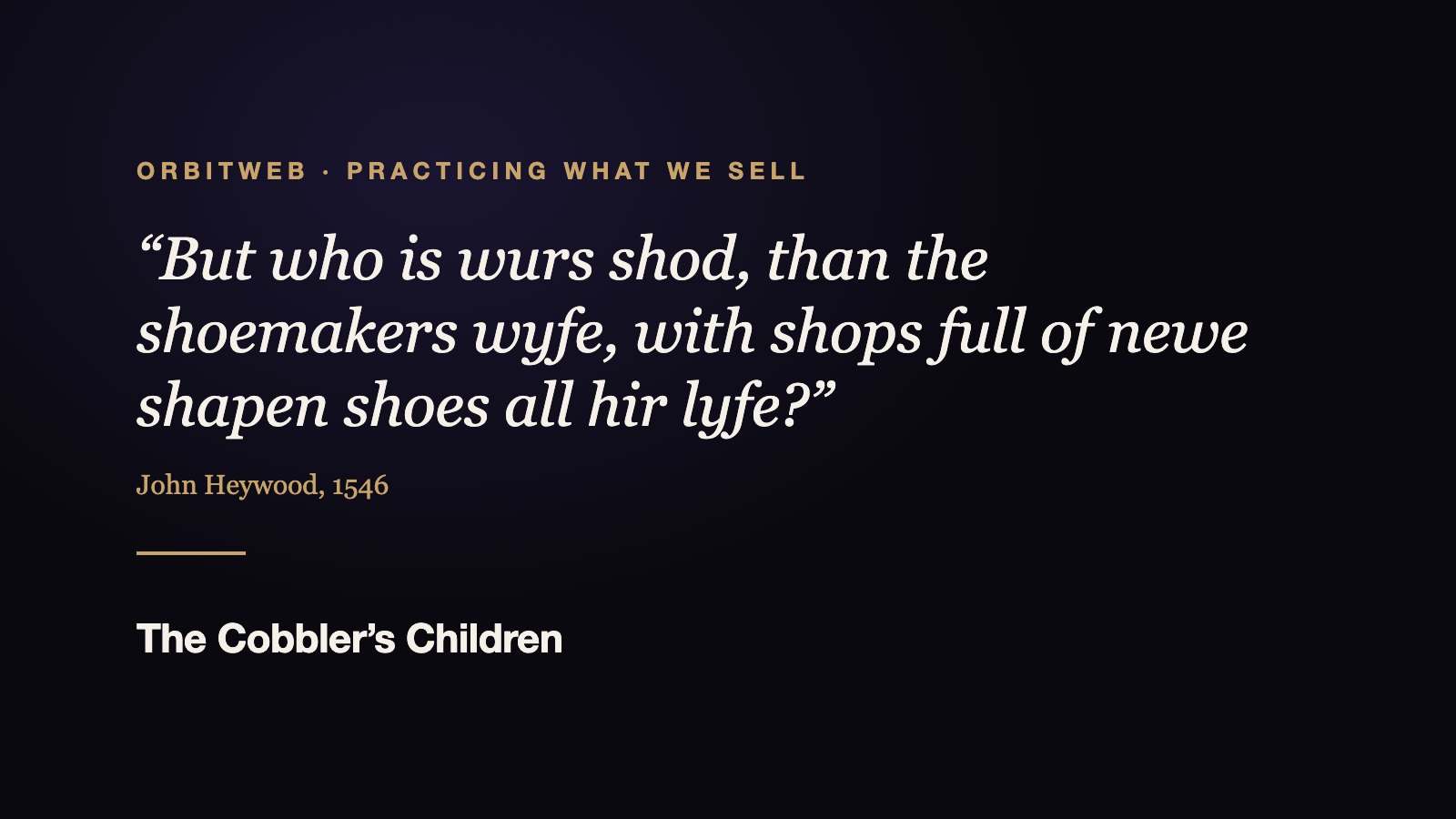
The saying is older than any of us. In John Heywood's 1546 collection of English proverbs, it isn't the children who go without, it's the shoemaker's wife:
"But who is wurs shod, than the shoemakers wyfe, With shops full of newe shapen shoes all hir lyfe?"
Shops full of new shoes, and the person closest to the shoemaker is the worst shod in town. Other versions name the shoemaker's son or the cobbler's children, and that's the one most of us know today. The idea is older still. "Physician, heal thyself" is in the Gospel of Luke.
Nearly five hundred years later, nobody has to explain it. Everyone has met the shoemaker.
Why the cobbler skips his own children
It's tempting to call it laziness. It isn't. Most cobblers I know work harder than anyone. The shoes don't get made for three quieter reasons.
Client work pays today. Your own site pays someday. When you sell hours, every hour spent on yourself is an hour nobody pays for. There's always a client deadline that's more urgent than your own homepage, and there always will be. The work you do for yourself loses every single priority meeting.
Knowing what's wrong feels like handling it. An expert can see every flaw in their own site in thirty seconds. That knowledge is strangely calming. You know the fix, so it feels like it's under control, when nothing has changed at all.
Your own work has to be perfect. For a client, you ship something good by Friday and improve it next month. For yourself, you wait for the version you'd be proud to show other professionals. That version never ships, so the old one stays up for years.
None of these is a character flaw. All three are the shape of a business that sells time.
I was a cobbler too
OrbitWeb started in Mississauga, and became OrbitWeb Inc. in February 2017. For years we built websites and ran Google Ads for local businesses. For MTS Moving, I built the website and ran their Google Ads, and their revenue grew 400%. The work for clients was the work I was proud of.
Our own site was a different story, and it had every one of those three excuses. I was busy working in the business, not on it. It took my own WebCore agent to point out what our site was missing: most of its words only appeared after JavaScript ran, so a search engine that didn't run it saw an almost empty page.
So this fall I gave orbitweb.net the audit I'd give any client, and rebuilt it so every page shows its words to a search engine without running JavaScript. The fix took one night, once the agent put it in front of me.
The last check is the hardest: ranking for our own job in our own town. We're working on that one in public, as an SEO agency in Cambridge.
What the person hiring you sees
Here's why it matters more than agencies like to admit.
A business owner can't see the work you did for your other clients. They can't log into anyone's analytics, and case studies are easy to polish. Your own website is the one piece of your work they can check without asking permission. It's your portfolio, your résumé and your first sales call, all at once.
Google itself tells business owners to be careful. Its guide to hiring an SEO says "No one can guarantee a #1 ranking on Google," and warns owners to "be wary of SEO firms and web consultants or agencies that email you out of the blue." An owner who has read that, and then finds your site on page five, has already made up their mind.
This week, at WebCore, we checked the homepages of 59 Ontario SEO agencies that rank on the first page of Google for their own trade in their own city. Three in four had all five basics in place: a title, a description, one clear headline, business details for search engines and a sitemap. One in four missed at least one. Those are the agencies you can find. If you're hiring, the full checklist is in How to Choose an SEO Company: Check Their Own Website First.
A buyer can't audit your clients. They can audit you.
Why we stopped selling hours
The honest answer to the cobbler's problem isn't guilt. It's arithmetic.
The playbook worked. The hours were the problem. Every page we built, every speed fix and every update waited for a person to get to it, and our own site was always last in line. Shoes don't get made because the shoemaker's time goes to paying customers. Telling him to try harder doesn't change the math.
So I changed the math. I built WebCore, an AI agent that runs the same playbook on every site it manages, and it doesn't skip the one it lives on. Today, OrbitWeb's main work is moving businesses onto it. Agencies can use it the same way, through our partner program, so they stop choosing between their clients' sites and their own.
That's the part of the old saying nobody mentions. The cobbler's children don't go barefoot because the cobbler doesn't care. They go barefoot because there's only one cobbler.
Practicing what you sell
If you run an agency, here's what I'd tell my younger self.
- Make your own site your first client. Put it on the calendar with a deadline, like any paying job.
- Run your own audit on yourself. Whatever checklist you sell, run it on your site every quarter, and fix what it finds.
- Rank for your own job in your own town. It's the cheapest proof you'll ever have, and every buyer will check it.
- Publish your own numbers. If you sell speed, show your speed score. If you can't, that's your first project.
- Sell what you can practice. If you can't spend the hours on yourself, find a way to get the work done that doesn't depend on your hours.
And if you're the one hiring: before you hire anyone to fix your shoes, look at their feet.
Frequently Asked Questions
What does "the cobbler's children have no shoes" mean?
It means people often neglect, at home, the very thing they're best at doing for others. A shoemaker busy making shoes for customers doesn't get around to his own family's.
Where does the saying come from?
It's centuries old. John Heywood's 1546 collection of English proverbs has an early version about the shoemaker's wife being the worst shod. The same idea appears in "Physician, heal thyself," from the Gospel of Luke.
Why do so many marketing agencies have weak websites?
Client work pays now and their own site doesn't, experts feel their own problems are handled because they understand them, and they hold their own site to a standard so high it never ships.
How can I tell if an agency practices what it sells?
Search for their service in their own city, run their homepage through Google's PageSpeed Insights, and check that the basics are in place. Our five-minute checklist walks through each step.
Sources
- John Heywood, A Dialogue of Proverbs (1546), quoted in The Cobbler's Children Have No Shoes: Meaning and Origin; variants in Wiktionary
- Luke 4:23, "Physician, heal thyself"
- Google Search Central: Do you need an SEO?
- WebCore: How to Choose an SEO Company, checks of 59 Ontario SEO agency homepages, November 4, 2026