Web Development & AI
AI agents website: what makes it genuinely useful?
By Rigo Guadrón · · 8 min read
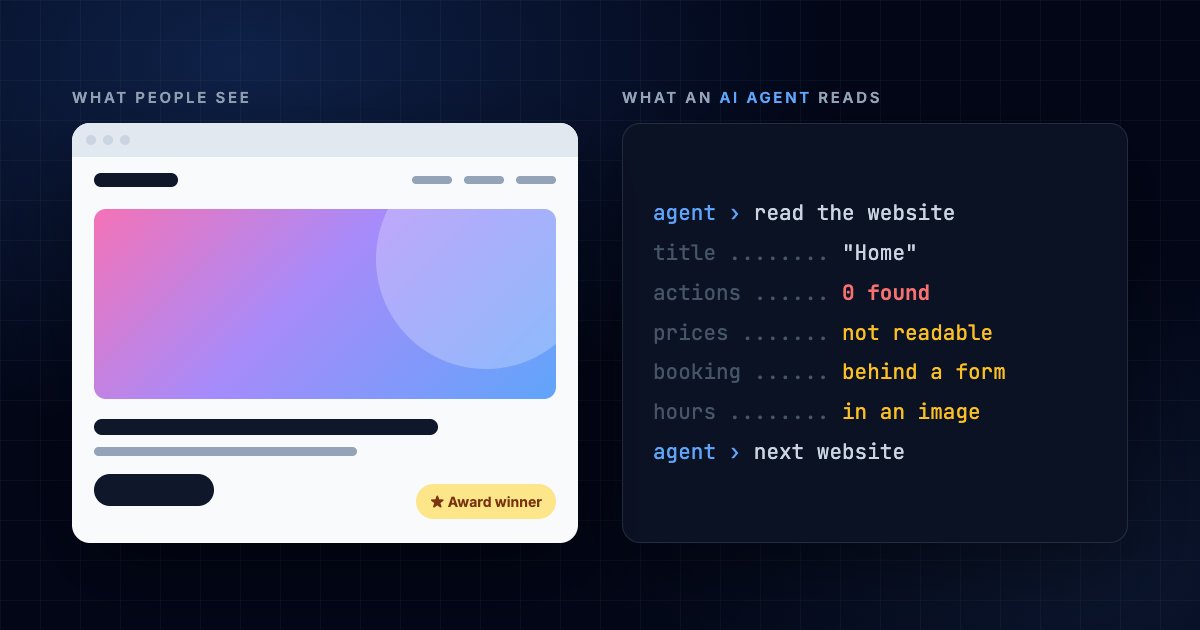
AI agents don't have eyeballs. They can't see your beautiful paint job or care about your awards. They read. And if your site has no user manual for them, you're already invisible.
Quick Answer
An AI agents website is a site built so autonomous software, not just human visitors, can read its capabilities, understand its actions, and execute tasks without clicking a single button. That means exposing your business logic through something like a Model Context Protocol endpoint instead of burying it inside a contact form only a person can find. Award-winning design does nothing for an agent that can't see design at all, it only reads code.
Your site just won an award. Framed certificate, LinkedIn post, the whole celebration. Nobody told you the judges who matter most five years from now can't see a single pixel of it.
That's not a metaphor. AI agents don't have eyeballs. They don't scroll, they don't admire your parallax hero section, and they definitely don't care that your typography won a design blog's "best of" list. They read. Code, structure, endpoints. That's the whole toolkit. If your site's genius is locked inside a visual layer built for humans, an agent walks right past it like it doesn't exist.
Why an AI Agents Website Isn't Just a Trend Term
An AI agents website is a specific kind of build, not a marketing buzzword bolted onto a normal WordPress theme. It means your business logic, your booking flow, your pricing rules, your contact process, exists somewhere a machine can actually parse it, call it, and get a structured answer back.
Most business sites today fail this test badly. They were built entirely for a person with a mouse. Every capability sits behind a button, a form field, a page a human has to physically discover by clicking around. An agent doesn't click around. It looks for a defined action it can invoke directly, and if that action doesn't exist in a readable format, the capability might as well not exist at all.
This distinction matters more every quarter, not less. The businesses treating this as optional are quietly building on top of a foundation that's already outdated.
The Split Nobody's Talking About Yet
Here's the thing that's easy to miss because it happened quietly. There are now two completely different users hitting your website, and they don't experience it the same way at all.
A human uses a front-end. They see a nav bar, click "Contact Us," fill in a form, wait for a reply. An AI agent uses an endpoint. It doesn't click anything. It looks for a defined, machine-readable action it can call directly, get a response from, and act on.
Your contact form, your booking widget, your pricing calculator, all of that capability is bolted onto a specific page that a human has to physically find and interact with. To an agent, none of it exists. Not because the agent is dumb. Because you never gave it a door.
The sites that can't be read by AI won't get a bad ranking. They'll get ignored completely, the same way a store with no sign gets ignored by someone walking down the street.
Why "Award Winning" Is About to Become a Dated Compliment
Web design agencies have spent roughly two decades selling business owners on aesthetics as the main event. Beautiful hero images, smooth animations, a font pairing that feels expensive. And look, that stuff isn't worthless, humans still buy with their eyes.
But here's the uncomfortable part. That era of aesthetics-over-function was really a proxy war. Nobody could easily prove a website worked, so everybody optimized for what they could see and judge: does it look impressive. Awards became the scoreboard for an entire industry that was mostly guessing at real business impact.
AI agents don't play that game. An agent doesn't care if your button has a nice hover state. It cares whether it can find a function, call it, and get a structured answer back. The UI, the whole visual layer you paid a design agency a small fortune for, is becoming a secondary, optional skin sitting on top of the thing that actually matters: the engine underneath.
The Clunky Fix Everyone's About to Try (And Why It Won't Work)
You can already see the next bad idea coming from a mile away. Somebody's going to ship a WordPress plugin, basically a "Yoast for MCP," that makes you manually type out every business action your site can perform into a settings page.
That's not a fix. That's a brittle prison dressed up as a solution.
Manual entry means every time your business changes, adds a service, updates pricing, tweaks a process, a human has to remember to go update the plugin too. Forget once and your AI-facing capabilities silently drift out of sync with your real business. You end up maintaining two versions of your website by hand: the one people see and the one you're hoping an agent believes.
What Actually Works: Reading the Engine, Not Retyping It
The better path skips manual entry entirely and reads your site's actual server-side code, the well-structured engine logic, function names, parameters, and existing code comments, to automatically generate an accurate machine-readable map of what your site can do. Think of it as a one-click introspection process instead of a data-entry chore.
Instead of a person guessing what to tell an AI agent, the system scans what your engine genuinely does and produces a live capability file that stays accurate because it's pulled from the source of truth: your actual code. Change the code, the capability map updates. No plugin to babysit, no drift between what you say your site does and what it actually does.
This is also where the work naturally expands. Once an engine is legible to machines, you can layer in more skills on top of that same foundation, security checks that an AI agent can run against your site, and performance or speed testing an agent can trigger and interpret without a human running a manual audit.
| Old Model (Award-Winning Front-End) | New Model (Engine-First, Agent-Ready) |
|---|---|
| Built for human eyeballs and clicks | Built for machine-readable actions |
| Capabilities hidden inside pages | Capabilities exposed as callable functions |
| Manual plugin data entry | Auto-generated from real server code |
| Judged by visual awards | Judged by whether an agent can act on it |
| UI is the whole product | UI becomes an optional layer |
Where This Is Actually Headed: WebMCP
Here's the end-state, and it's closer than most business owners want to believe. WebMCP is the natural conclusion of all this: voice and chat-based interaction where the interface itself mostly disappears.
Picture it. It's 2 a.m., you've got a marketing idea, a promotion, a landing page tweak, whatever. Instead of emailing your agency and waiting for someone to "look at it tomorrow," you just tell your AI agent to execute it. No blue link to click. No waiting room. You get a response, and you go back to bed.
That's not science fiction, that's just what happens once your engine is properly exposed and an agent can call it directly. The front-end, the thing your last agency charged you a premium for, becomes almost decorative. Nice to have for the humans who still browse. Irrelevant to the agents doing the actual work.
Nobody Knows the Exact Timeline, and That's Fine
Look, I'm not going to pretend I know if this fully lands by 2030, 2045, or 2060. Nobody honestly knows that. What you can do is look at the trend lines and the tech already shipping right now, and it's pretty obvious which direction this is moving.
That's actually the reassuring part, not the scary part. Because it means an engine-first, agent-ready foundation isn't a dead-end investment you're betting blind on. It's infrastructure. You're paying for one real piece of a much bigger revenue machine that's still being assembled, and every piece you build now compounds instead of getting thrown away later.
The business owners who treat this as "wait and see" are going to be retrofitting an entire site under deadline pressure while everyone else is already answered by agents that never sleep.
Key Takeaways
- AI agents read code and endpoints, not design; a visually award-winning site can be functionally invisible to them.
- Contact forms and bolted-on capabilities only work for humans who can physically click; agents need a defined, callable action.
- Manual-entry plugins for AI readiness create drift and maintenance debt; auto-generated capability maps from real server code stay accurate.
- The natural endpoint of this shift is voice and chat-driven execution, where the UI becomes optional and the engine does the work.
- Nobody can predict the exact year this fully arrives, but the trend and the tooling already point one direction, so building engine-first now is infrastructure, not speculation.
FAQ
What is an AI agents website?
An AI agents website is a site engineered so autonomous AI software can read its structure, understand its available actions, and execute tasks directly, rather than relying on a human to click through pages and forms.
What does Model Context Protocol mean for a website?
Model Context Protocol, often shortened to MCP, is a standard that lets a website expose its real capabilities, like booking, pricing, or contact actions, as machine-readable functions an AI agent can call directly instead of guessing from a webpage's visual layout.
Why can't AI agents see a well-designed WordPress site?
AI agents don't render or interpret visual design the way humans do. They read code, endpoints, and structured data, so a beautifully designed site with no machine-readable capability map is effectively invisible to them, no matter how many design awards it's won.
Is manually entering business actions into an MCP-style plugin a good solution?
It's a fragile one. Manual entry requires a human to remember every update, which means the machine-readable version of your site quickly drifts out of sync with what your business actually does. Reading directly from your server-side code keeps that map accurate automatically.
What is WebMCP and how is it different from a website today?
WebMCP describes an end-state where voice and chat interaction let a business owner or their AI agent execute changes directly, no clicking through pages, no waiting on a human team, just an instruction and a completed action.
What to Do Next
If you're proud of your award-winning site, keep the award, seriously, that's not the enemy here. But go check whether your site's real capabilities exist anywhere a machine can read them, or whether they're still locked behind a form only a human would ever find. That single audit tells you which side of this shift you're currently standing on.
Let’s look at your website together
Book a call and we will look at your site with you: what to keep, what to fix and what moving to WebCore would change.
Related reading: explore how server-side engine architecture affects AI readability, what a Model Context Protocol endpoint actually looks like on a live site, and how WebMCP-style voice execution compares to traditional web development workflows.